Explore therapeutic Tarot in dialogue with Jungian ideas such as archetypes, shadow, projection, and individuation, with clear ethical and scientific boundaries.
A card does not know your biography
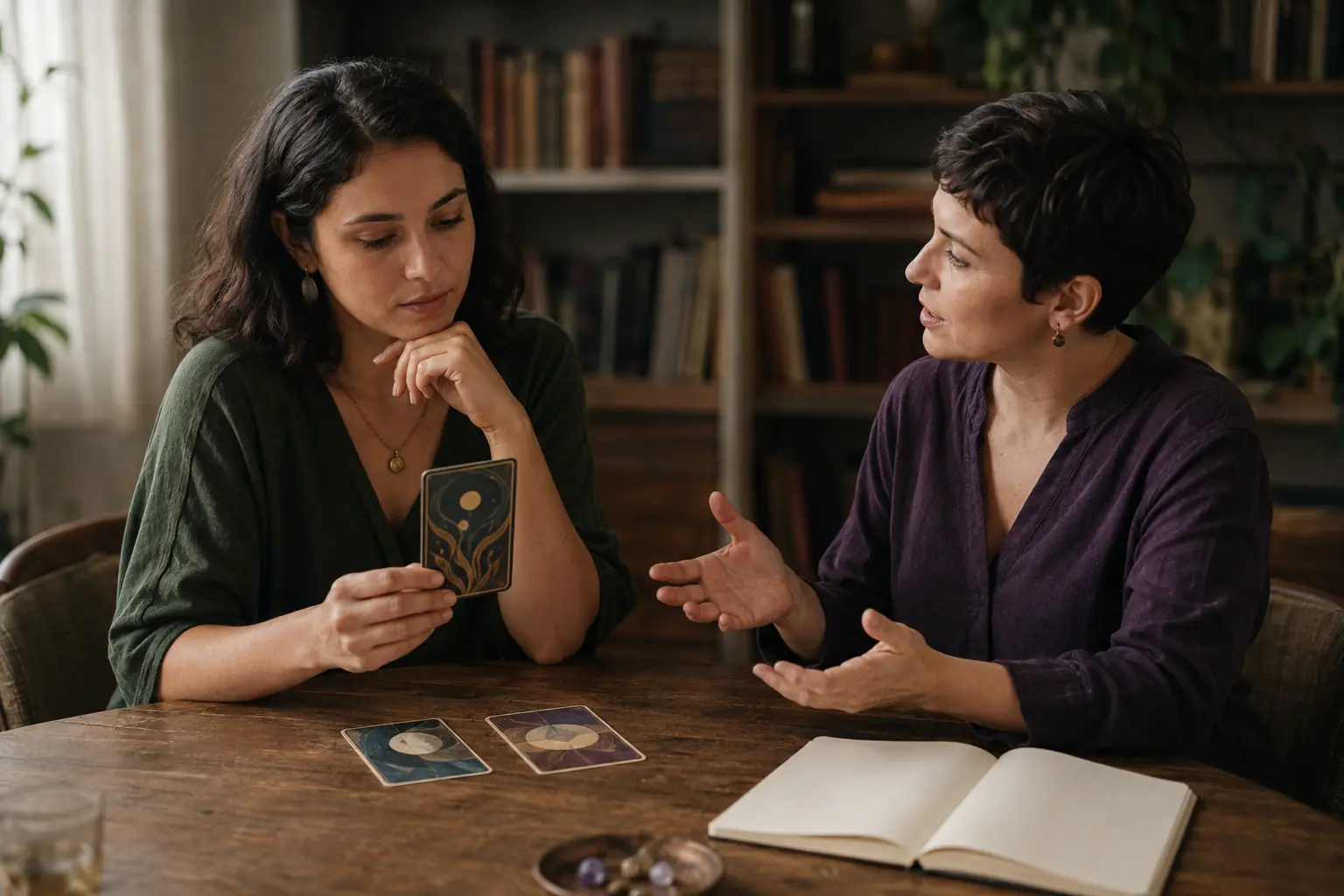
Imagine a card showing someone at a crossroads, another showing a structure struck by sudden change, and a third showing a person carrying more than they can comfortably hold. The images know nothing about the viewer. Still, one may evoke a memory, organize an unspoken tension, or bring forward a question that ordinary conversation had not reached. Therapeutic Tarot is most useful in this interval between image and interpretation.
The expression does not name a regulated psychotherapy, and a deck is not a validated psychological test. The word therapeutic describes an intention: to use symbols in a reflective, non-fatalistic conversation that may support self-awareness. That distinction protects both the client and the practice. It prevents a reader from borrowing the authority of clinical psychology while making claims that the method cannot establish.
From Renaissance game to contemporary symbolic practice
The earliest surviving Tarot cards appeared in fifteenth-century northern Italy and were associated with courtly card games. Divinatory and occult systems developed later. The history matters because it challenges the idea that every contemporary interpretation descends unchanged from one ancient secret. Tarot has been repeatedly redesigned by artists, esoteric schools, readers, and cultural movements.
Today, the seventy-eight-card structure can be approached as a repertory of human scenes: desire, conflict, authority, loss, care, risk, waiting, rupture, and renewal. The reflective value does not depend on proving that a card was supernaturally selected to reveal a hidden fact. A question such as “What in this scene has your attention?” invites agency. A declaration such as “This card proves your partner will betray you” replaces inquiry with suggestion and fear.

What Jung contributes—and what he does not
Carl Gustav Jung gave sustained attention to dreams, myths, symbols, complexes, projection, and the process he called individuation. Archetypes, in broad Jungian language, are organizing patterns that become visible through recurring images and narratives. They are not simple character labels, and there is no official Jungian chart in which each Tarot card equals one psychological archetype.
Jung did not establish a clinical Tarot protocol. The connection is a later interpretive development. It can be intellectually fruitful when concepts are used carefully: a card may help someone notice what they admire, reject, fear, or assign to another person. It becomes misleading when “archetype” is used as a scientific seal for any prediction. Contemporary scholarship continues to debate the different meanings of archetype in Jung's writings and the empirical status of his claims.
Shadow, projection, and individuation
The shadow refers, in simplified terms, to aspects of experience that a person does not comfortably recognize as their own. A strong reaction to a card can open a question: why does this figure seem unbearable, admirable, weak, dangerous, or seductive? The answer may reveal a conflict or projection, but it should remain a hypothesis—not a diagnosis imposed by the reader.
Individuation is often reduced online to “becoming your best self.” In Jungian thought it is closer to a difficult process of becoming more psychologically whole, including tensions that cannot be erased by positive thinking. Tarot can support this work only modestly: by offering images around which a person may organize a narrative, compare possibilities, and acknowledge contradiction. The actual work takes place in reflection, relationship, and lived choice.

A responsible therapeutic reading
A careful session begins by defining the question and the scope. The reader describes the method, avoids guarantees, distinguishes observation from interpretation, and invites the client to test meanings against their own experience. Useful prompts include: What does this image make easier to say? What alternative story could also fit? What evidence supports this fear? Which part of the situation is under your influence?
A responsible reader does not diagnose illness, prescribe treatment, encourage abrupt medication changes, announce death or pregnancy, replace legal or financial advice, or use frightening predictions to create dependence. When a person presents risk, severe distress, or a need outside the reader's competence, referral is part of ethical care. The best outcome is not obedience to the cards; it is greater clarity and restored authorship.